Unknown's avatar

About Stephan Droege

With a specific focus on characterful and overachieving wine in the $15 to $18 price-point range, DéClassé aims to expand the readers' taste and curiosity about a diversity of wine styles--while exploring the winemakers in a cultural and historical context. Thank you for visiting the site!

Nouveau Alert

Beaujolais, one of the world’s oldest wine regions, has always produced a share
of unassuming young wines not destined for anyone’s cellar. Of the total output
of its regionally distinctive varietal wines, nearly 30% is exclusively finished and
marketed under the Nouveau designation. They invented the concept; they’re
arguably still the best at making it. Historically, the barely-off-the-vine, bright and
uncomplicated batches of wine were intended to be consumed as a celebration of
the current vintages harvest, Vin de l’année. Following on long summer months
spent waiting and praying for the season to be a bountiful one, came arduous
weeks of picking, hauling, destemming, sorting and a short fermenting period.
For the dedicated labourers, being gifted a few bottles of the freshly made juice
was a small and well-earned reward. The shipping of Beaujolais Nouveau abroad
as a major export, though, is a relatively contemporary concept that only became
widespread in the middle of the 1950’s; hitting its commercial peak around 1980.
This unique timed-release on the 3rd Thursday in November remains celebratory,
but perhaps has become misunderstood or misrepresented over time.

In general, over-production or indiscriminate winemaking by some of the largest
producers have given this specialty wine a mixed reputation; confusing ever-more
discerning drinkers with undue levels of aromatic character such as ‘bubblegum.’
and ‘twizzler’ (red licorice). No doubt, some of the opportunistic bottling that’s on
offer is fairly reflected by these descriptors. However, many of the small, and a
few large producers are capably fashioning a better balance in the quality of the
fruity and charmingly simple wines that are possible with the Gamay grape: the
region’s pleasingly tart, flagship variety also known as Gamay Noir à Jus Blanc.
Among the leading vintners is Joseph Drouhin, originally hailing from yet another
noteworthy wine region, Chablis. With a move to Burgundy in 1880, he founded
his new Maison in the wine capital city of Beaune. Building on his pioneering work,
four succeeding family generations have continued the refinement; progressively
becoming masters of both the Nouveau and regular Beaujolais wine styles.

In order to produce, bottle, and release the wine within a few weeks of picking,
vintners use carbonic maceration as an alternate method to accelerate the
finishing process. Unlike a more traditional practice of crushing the grapes and
allowing the juice to ferment alongside the skins, leeching out a deeper colour
and higher levels of tannin into the mash; in carbonic maceration, the fruit is left
whole, in closed vats that have been flushed with carbon dioxide to purge oxygen.
The grapes begin fermenting inside their skin before the combined pressure of
the fruit’s weight and the released gasses squeezes the alcoholized juice out.
Filtered and briefly aged in stainless steel tanks, the process yields a very lightly pigmented and almost tannin-free Nouveau wine.

For this week’s DéClassé feature Joseph Drouin Beaujolais Villages Nouveau,
note that the Villages designation represents a qualitatively better grade of the
terroir-specific source of the grapes. Along with some added care in processing,
these factors result in slightly higher pricing than the other standard fare. Dare
to invest a few extra dollars, to regain an appreciation for this iconic wine style.
For those that deride Nouveau, generally, as being immature wine lacking depth
and dimension; pay little attention, they’re truly missing the delightful point!
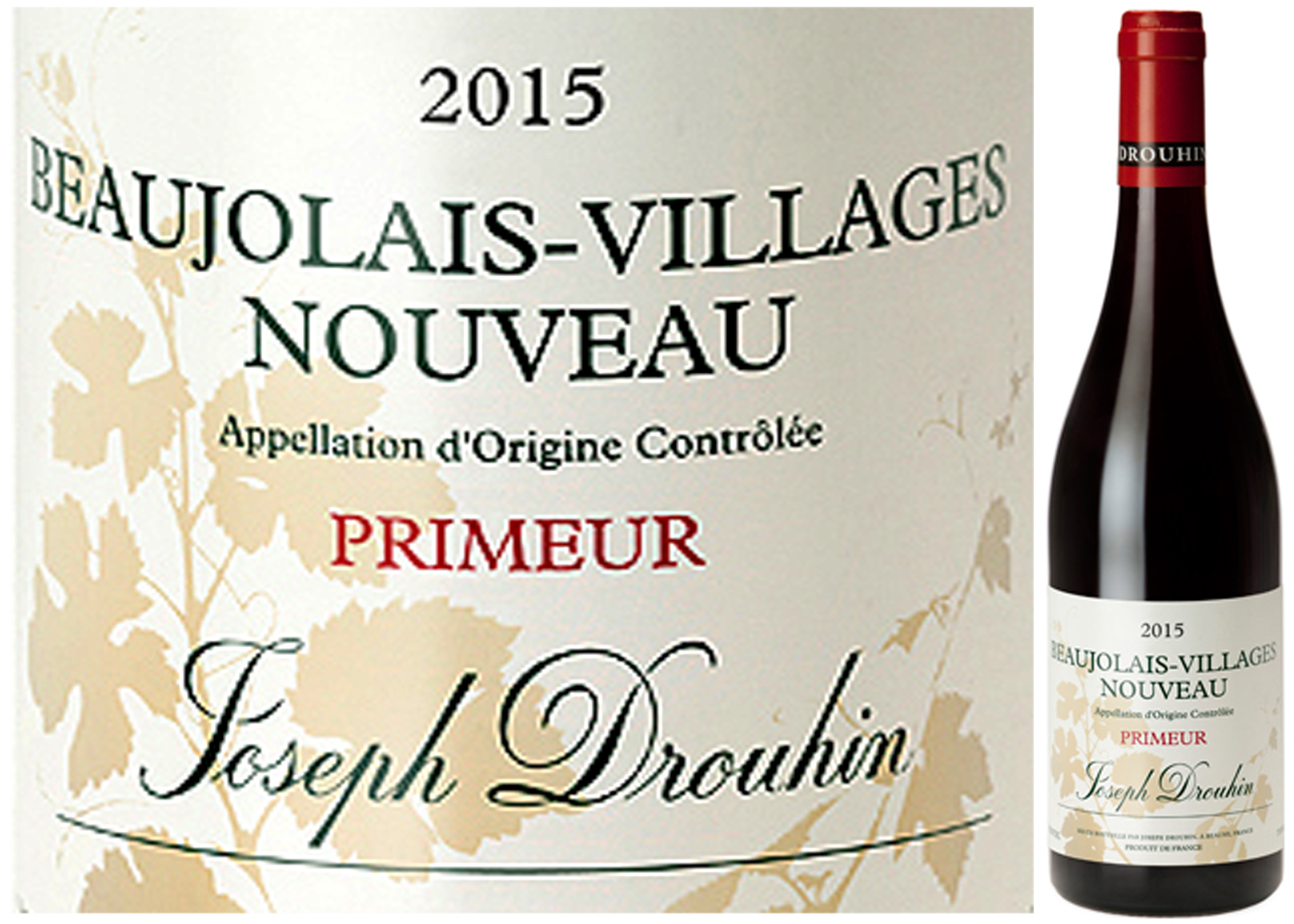
Joseph Drouhin

JOSEPH DROUHIN BEAUJOLAIS VILLAGES NOUVEAU
VINTAGES – Product #113266 | 750 mL bottle
Price $ 15.95
12.5% Alcohol/Vol.
Sugar Content: XD

Made in: Beaujolais, France
By: Joseph Drouhin S.A.
Release Date: November 19, 2015

Tasting Note
This light Garnet-coloured, easy drinking wine, has a zingy bouquet and flavours
of cherry and berries. Try serving very lightly chilled as an apéritif with pâté and
savoury hors d’oeuvre, Gruyère cheese and beef fondue or substantial main
dishes such as roasted poultry and herb stuffed pork.
Appassimento Alert

Still hard at work in the renowned and garden-like vineyards surrounding Verona,
an unbroken line of vignaiolo at Masi have built up, then diligently passed on their
wine-making knowledge. As of acquiring the Vaio dei Masi namesake property in
1772, these family vintners have steadily developed a largely unrivalled mastery
with the region’s indigenous grapes: Corvina, Rondinella and Molinara. Up until
the early medieval period, the desirable hillside tracts of fertile soil and prolific
vines, dependably fed by a lattice of brooks in the Adige River watershed, were
independently named valleys: Vallis Provinianensis; rolling out northwest of the
famed city and vallis Veriacus to the east. In time, the reference to these and an adjacent plain were combined, becoming vallis Pulicella. Modern Italians along
with the rest of an appreciative wine world, now succinctly call it Valpolicella.

Circa the 12th century and onwards, the ‘valley of many cellars’ has been under
the stewardship of the Veronese nobility and prosperous mercantile collaborators
who would follow in their footsteps. Multi-generational family oversight of long
standing estates while drawing on locally rooted agricultural expertise, has been
a guiding formula for consistently good winemaking. Since the glory days of the
Serenissima Republia (‘Serene Republic of Venice’), promoting distinctive quality
levels while also bolstering the export potential, has developed hand-in-hand. It
makes for very good business. It might also reveal that the process of becoming
a large and successful vintner doesn’t necessarily translate into production of
unremarkable wine. It is possible to output large amounts of well-made wine, so
long as basic cultivation balances are maintained: judicious pruning to compact
yields, optimal planting density and an indispensable hands-on tending to the fruit.

This week’s DéClassé featured Boscaini family are doing well at balancing scale
with the maintenance of quality–by continuing to explore innovation and applying
the updated techniques to traditional recipes. Among the host of noteworthy
wines from this globally recognized brand is a so-called ‘Super Venetian.’ Making
a relatively modern debut in the mid-1960’s, this wine’s finishing process is yet
another variant of the Greek grape drying technique called passito, then further
refined in Roman winemaking. Historically used to create sweet wine styles such
as Recioto della Valpolicella, it was gradually adapted under the umbrella term of Appassimento, yielding a range of drier, though still immensely rich wines such
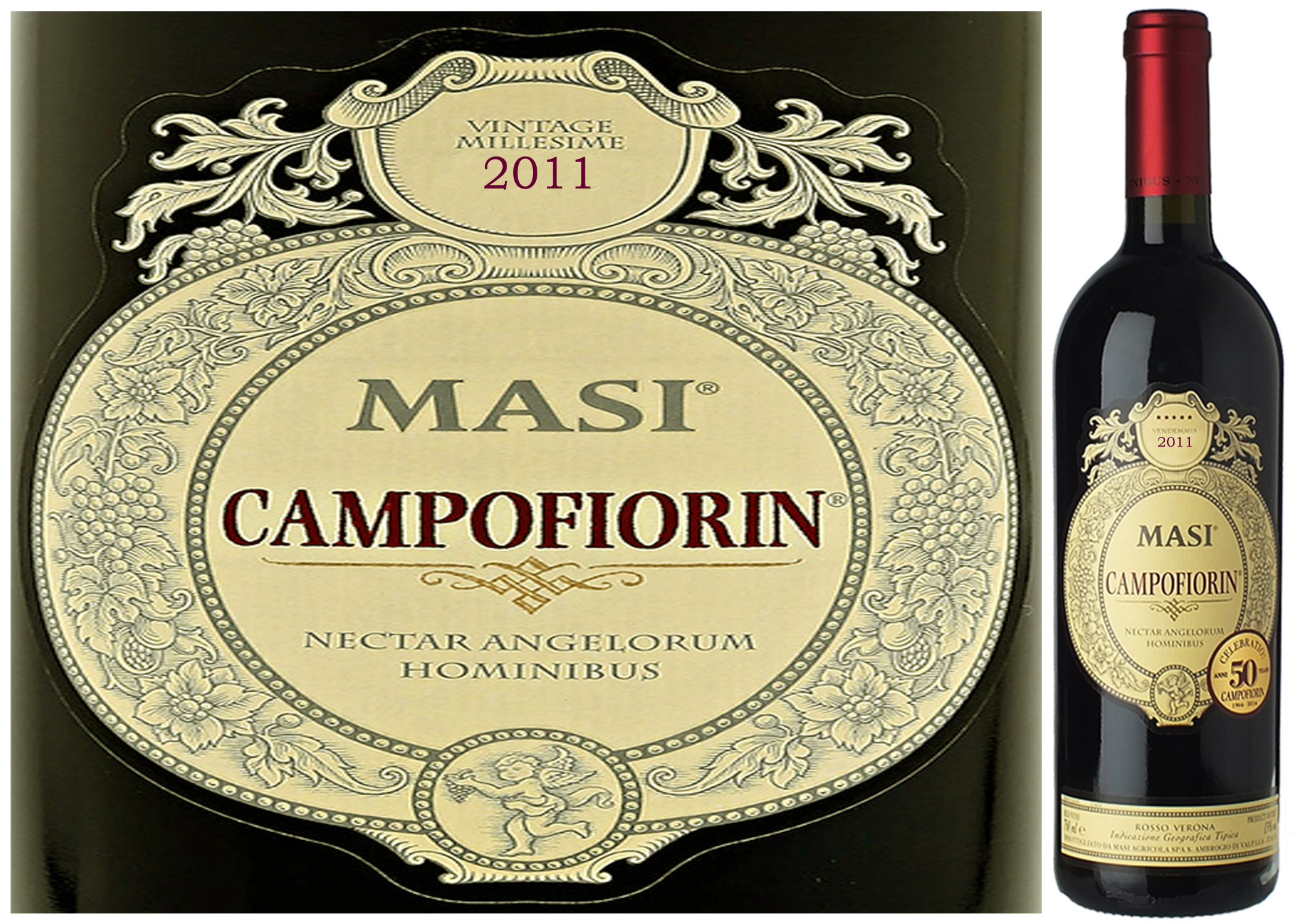
as Amarone and various types of Doppio Passo or Ripasso: like the 2011 vintage
of Campofiorin, whose striking label bears a bold Latin subtitle and aspiration:
Nectar Angelorum Hominibus (‘Nectar of the angels for men’)!

When this bottling and it’s patented finishing process was introduced 50 years
ago, it was hailed as a new category of wine. The innovate use of freshly dried
grapes, as opposed to second-use of Amarone must, prompts a slightly more
vigourous 
second fermentation and enriching of the young base wine. Practiced
drinkers of Ripasso will nonetheless recognize its heritage, conveying a plummy,
plush and fulsome style; one which always seems more at home with the richer
food fare around Christmas. Usually selling just above the traditional DéClassé
price-point, the current $3-off sale makes it a bargain; as a robust dinner wine
addition. Remarkably, this 
has sufficient body to withstand several decades of
cellaring–buy plenty and see if you’re able to hold onto some!

Campofiorin

MASI CAMPOFIORIN 2011
LCBO Product #155051 | 750 mL bottle
Price $ 19.95
Sale $ 16.95
13% Alcohol/Vol.
Sugar Content Descriptor: D

Made in Veneto, Italy
By: Masi Agricola S.P.A.
Release Date: Sale through November 28, 2015

Tasting Note
This has a densely layered set of aromas and flavours including cherry and plum,
currants and sweet spices. As expected from a Ripasso wine, it’s velvety and
versatile; suitable to richer food fare. Try as apéritif with spicy meat-filled Phyllo
wraps, baked and well-aged cheeses, or to keep up with Bavette steak, grilled
lamb kabobs and suckling pork with fire-roasted vegetables.

Chenin Blanc Alert

In the 1650’s, while back-breakingly toiling to create fields at the end of a rutted
ox wagon trail; connecting with the small coastal outpost of Cape Town, farmers
also had to keep their ears tuned for a tell-tale shot ringing out from the heights
of Kanonkop (‘cannon hill’). Repeated by a string of relay-cannons, the booming
signal would eventually reach the remotest inland settlements; announcing the
arrival in port of a sailing ship requiring fresh provisions! Resupply and repair of
the Dutch East India Company’s Maritime fleet, at the southern outcrop of Africa,
was a compelling motivation in the 17th century for founding Cape of Good Hope
as a refueling station; critically positioned halfway between Atlantic home ports
in the Netherlands, and the Indonesian trade colonies of Batavia that lay across
the Indian Ocean and Java Sea. Included on the checklist of ships’ stores was a
need to replenish bottled spirits. The French Huguenot settlers–who had been
enlisted by the Dutch company recruiters–were quick to transplant grapevines
into this untapped agricultural paradise, then sell onboard the finished wines!

It was never an empty land, though; the fertile plains, valleys and microclimates
of Southern Africa have always been an alluring destination for migrant Peoples.
Up until roughly the 15th century, it was nomadic Swazi, Ndebele, Xhosa, Tswana
Zulu, and Sotho who had gradually moved themselves, their herds and cropping
expertise–from formerly traditional regions in central Africa into less-populated
areas further south. Despite a 350-year historical record of profound disparity
between these diverse African cultures and their German, Dutch, French and
English colonial counterparts, inflamed by dark periods of outright enslavement;
the 21st century is witnessing a profoundly revised and hopeful chapter unfold.

The Western Cape Province, including the colloquially titled Cape Winelands,
was one of the now-disreputable ‘white and coloured preferred’ zones during
the apartheid era. The heartland town and surrounding region of Stellenbosch
was no exception to this ethnic segregation; 25-years-on, it has blossomed into
the dynamic centre of the South African wine industry; hosts a world-renowned
university, and most importantly: is one of the leading examples of reconciliation
and ongoing redistribution of the benefits that this rich land offers. As for the
less-consequential pursuit of winemaking—don’t say that to the rightfully proud
local vintners—the homegrown and export market has never seemed brighter!

For this week’s DéClassé recommended winery DeMorgenzon (‘morning sun’),
the property’s name refers to its position on the crest of the high-altitude Kloof
Valley—so their vineyards are the first to see warming daylight. Enlightenment
abounds here, including the delightfully idiosyncratic practice of piping Baroque
music out over the grapes to stimulate development! Carl Van Der Merwe is
among a younger generation of SA winemakers whose modernized philosophy
also includes fostering vineyard biodiversity. The reintroduction of native flowers
and plants, while leaving select areas to flourish in a natural state, demonstrates
an eco-sensitive balance of land-use and a move away from sterile monoculture.
Though the DMZ sub-brand marks DeMorgenzon’s entry-level wines, the quality
of this Chenin Blanc bottling and its approachable price point is an auspicious
introduction that needs little more qualification than: it’s a freshly understated,
somewhat less-honeyed version; nonetheless flavourful, very well-crafted wine!

Demorgenzon

DEMORGENZON DMZ CHENIN BLANC 2015
VINTAGES – LCBO Product #429522 | 750 mL bottle
Price $ 14.95
14% Alcohol/Vol.
Sugar Content Descriptor: XD

Made in Western Cape, South Africa
By: DeMorgenzon
Release Date: October 31, 2015

Tasting Note
This is a reasonably fulsome, bright style of Chenin with pear, apple, and light
citrus fruit aromas carried along into some subtle, honeyed-nut flavour notes.
Try serving with vegetable soufflé, butternut squash soup or Asian cuisine.

Chianti Alert

Sangiovese Grosso, Sangiovese Piccolo, Sangioveto ….. is to name just a few of
the aliases for this grape and closely related cultivars; providing the core body
for most Tuscan, blended red wine recipes; still reigning as the most consumed
Italian wines–at home and abroad. Dark-blue-skinned Sangiovese takes its name
from the Latin term Sanguis Jovis (‘blood of Jove’); an exalted reference to both
the elixir’s colour and an esteemed place in Europe’s pantheon of great grape
species: Vitis Vinifera. It’s also the most widely cultivated variety in central Italy,
with prolific vineyards in Lazio, Umbria, Marche and Tuscany combining for 95%
of worldwide plantings–a largely unrivalled dominance of a major grape, sourced
from a single country. Over several hundred years, generations of growers have
steadily built up expertise with ‘San-joh-vay-say’; stewarding these slow ripening
fruit clusters through to balanced maturity is something Tuscans have diligently
become very, very good at!

In the viticultural history of many long-lived old world wine regions, development
of a distinctive wine style that becomes immensely popular, aided by prodigious
yields of grapes that are well-suited to the terroir, adds up to a mixed record of
glory times and a fair share of winemaking folly. The sometimes over-voluminous
output of Tuscany’s Chianti is no exception to the latter. Happily, the decades in
the mid-20th century during which large commercial producers were marketing
far too much unremarkable bulk wine dressed in attractive round-bottom flasks,
swaddled with woven raffia called Fiasco–are long gone. In its 21st century place,
aptly, a renaissance of a different sort is taking place in the baseline of Italianate
winemaking. This time, Tuscany is focused on artfully advancing the competitive
quality across all its grades; from everyday offerings such as charmingly simple
Chianti thru to premium production of Brunello or Vino Nobile di Montepulciano.
Too bad about the general demise of the raffia wrapping, it was so rustically and
warmly emblematic of Italy for such a long time!

Among the undulating landscape to the south-west of Florence, the vineyards of
Fattoria Di Piazzano roll down and outward from the tree-ringed hilltop estate:
first established by debutante vintner Otello Bettarini in 1948, then overseen by
nephew Riccardo for a time, and now with another quarter-century of hands-on
experience and investment, the fattoria (farm) under guidance by Rolando, Ilaria
and Michela endures as a Bettarini family affair. This week’s DéClassé featured
bottle of Piazzano Chianti 2013 is evidently one of their entry-level wines from a
very limited release. Nonetheless, this is a delightful, lighter-bodied and youthful
Chianti, displaying an integrated character of savoury earth and still-vibrant fruit.
Generally, exercising restraint in the finishing process of wine displays modern
winemaking wisdom. Here, the straightforward recipe of 80% Sangiovese–likely
from young vine stock–is rounded by a healthy splash of Colorino and Canaiolo.
Exposure to wild yeast and aged briefly in vitrified concrete vats and bottle only,
results in an unfettered, honest and refreshing wine, pleasingly devoid of oak.
Add a $14.95 price-point and you have a winner that will sell quickly. I would buy
many, to fill empty slots in your loose-raffia-lined storage boxes, as the success
of this trial offering will probably prompt a price increase for the next vintage!

Piazzano

PIAZZANO CHIANTI 2013
VINTAGES – LCBO Product #393199 | 750 mL bottle
Price $ 14.95
13.5% Alcohol/Vol.
Sugar Content Descriptor: D

Made in Tuscany, Italy
By: Societa Agricola Fattoria Di Piazzano
Release Date: October 31, 2015

Tasting Note
This appealingly nimble young wine has a surprising range of the savoury thru to
cherry-driven flavours and aroma expected of Sangiovese. Try serving this with
antipasti, Pappardelle noodles and mushrooms or sausage-stuffed roast pork.

Primitivo Alert

In a period that Roman historians term as Magna Graecia, expansionist Greeks
crossed the westward seas to establish a ring of thriving colonies around the
perimeter of this distinctive land spit; in the modern age it became whimsically
known as either stiletto or heel of the boot. Jutting downwards from mainland
Italy, the southern peninsula of Puglia acts as a geographic divide between the
sheltered Gulf of Taranto and the Otranto Strait of the Adriatic Sea. Throughout
thousands of years in antiquity through to the middle ages, this was a strategic
crossroad of trade and target of conquest for many Mediterranean civilizations.
As a cumulative result, 800km of coast and the parallel line of inland mountains
now serve to frame a hybrid culture; unique within the broad diversity of regional
Italian identities. Though early colonizers seem to have been warlike Spartans,
by the 5th century BCE, it was philosophy that had become the preoccupation in
Greco-Italian centers of learning such as the city of Elea (now Velia). Notably, this
was home to visionary thinker and mentor Parmenides; credited with laying an
influential foundation for Aristotle, Plato and young Socrates. Unsurprisingly, the
wealth of clay Amphorae unearthed from archeological excavation also reveals
that the making of wines and their sea-borne export were well underway!

With naturally fertile reddish-brown soils, Puglia’s flat plains and valleys host a
proverbial abundance of wild rose and berries, rosemary and thyme; punctuated
by stands of stalwart maritime pine. As for the mixed agricultural landscape, the
widespread grain farming and groves of ulivi secolari (centuries-old olive trees)
yields an impressive 50% of Italy’s total pasta and olive oil production. Artichoke,
tomatoes, sheep herding, fish and seafood, and of course grapevines, round out
the bountiful output here.

Curiously, in spite of being so prolific, Puglia remains one of the less-well-known
Italian regions. In its middle and southern provinces, the hot and dry climate is
perfect for cultivating fulsome grapes such as Negroamaro, Malvasia Nera and
Primitivo. With a name derived from several Latin terms loosely translating as
‘the first to ripen’, Primitivo has traditionally been a reliable blending component.
More recently, the variety has gained increased profile as a stand-alone varietal
wine, due in part to the burgeoning popularity of Zinfandel; a clonal relative that
flourishes in Californian vineyards and North American marketplaces. Local lore
suggests that this Italian variant of a Croatian parent grape was discovered by
a 17th century Benedictine monk, Francesco Primicerius, as a wild vine growing
in his monastery gardens. Gradually, cultivars of Primitivo were then proliferated
throughout Puglia, finally rooting in Taranto Province 100 years later.

Home to this week’s DéClassé featured bottle from the Montanaro winemaking
family, the town of Crispiano and surrounding vineyards are proudly becoming
an agrotourism destination in their own right. So much so that these vintners
engaged a landscape architect, Fernando Caruncho, to oversee development of
the property as a garden-vineyard; wherein the undulating waves of vines are
interspersed with 24 islands of 800-year-old olive trees. Compelling aesthetics
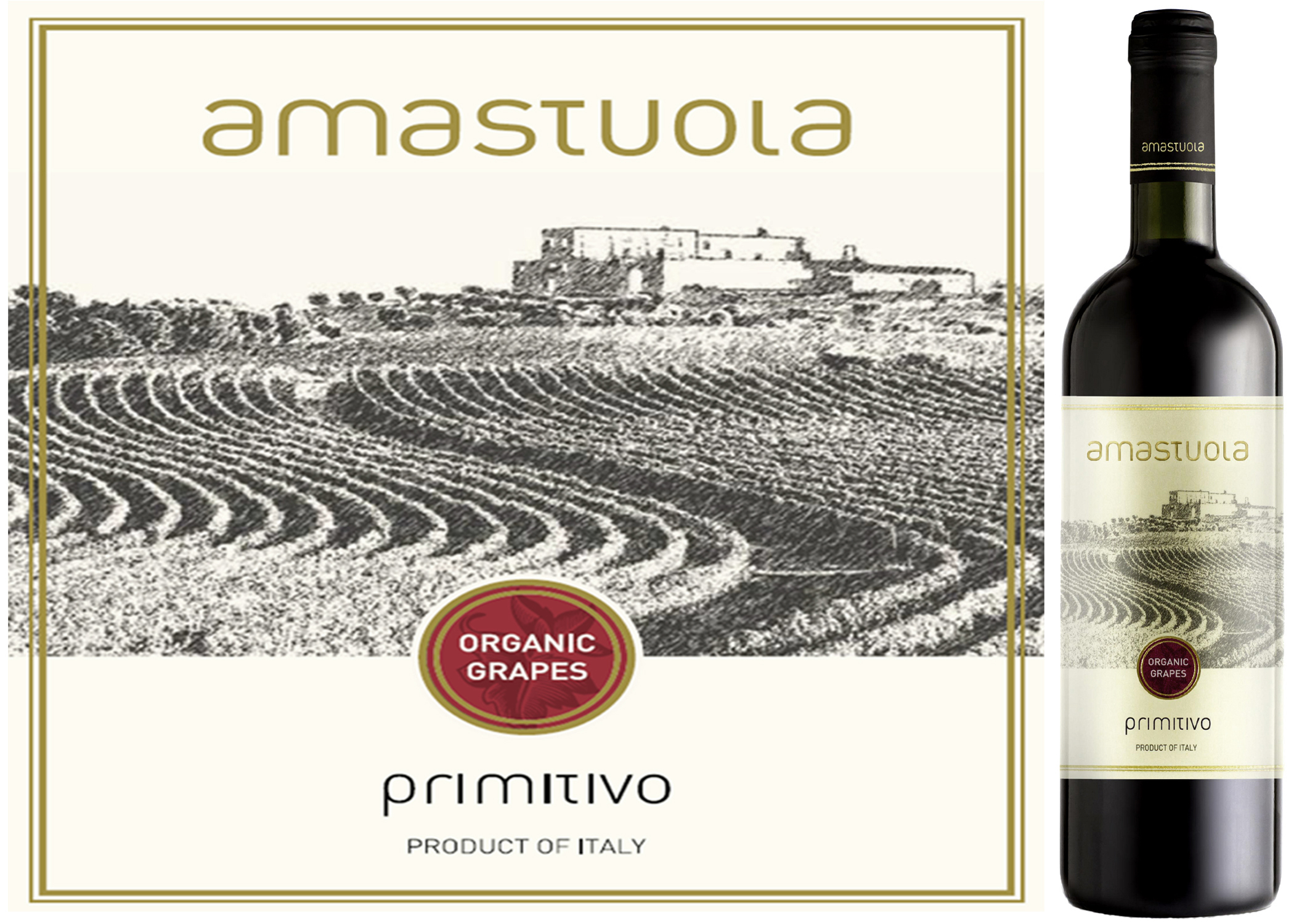
aside, their Amastuola Organic Primitivo is a plush, pleasingly rounded example
of how expert that Taranto’s vintners have become in fashioning their local wine.
Budget allowing–half a case would be hard to hold in your cellar for very long!

 
Amastuola2

AMASTUOLA ORGANIC PRIMITIVO 2011
VINTAGES – LCBO Product #300004 | 750 mL bottle
Price $ 15.95
13% Alcohol/Vol.
Sugar Content Descriptor: D

Made in Puglia, Italy
By: Amastuola Societa’S Agricola S.S.
Release Date: October 17, 2015

Tasting Note
A very fruity palate typical of the grape style with aromas of mixed berries, plum,
spice and vanilla. Try with some classic, cool-weather comfort foods like braised
beef brisket, veal scaloppini, pasta Bolognese or eggplant Parmigiano.

Syrah Alert

The central Atacama Desert is distinctively known to climatologists as the driest,
non-polar geography on Earth; desolate and desiccated to such extremes that
it’s biologically sterile, with some zones having never recorded any measurable
rainfall–ever. Here in the northern 3rd of Chile, to an unpractised outside eye, the
cultivating of fruit at the outer fringe of an expanding desertification seems likely
to be a futile exercise? Undaunted, the imaginative and resourceful Chileans are
applying their ancient understanding of the land while also employing innovative
and sustainable techniques such as drip irrigation–to excel in the face of these
challenges. Also blessed with a relatively pest-free environment, they’re naturally
exercising less-invasive, organic and biodynamic farming practices; both healthy
and more economical in terms of production costs. The sum of this viticulture
intelligence is imparting a discernibly fresh character into their premium wines,
while also compellingly demonstrating Chile’s new age, winemaking leadership;
now becoming an additional, largely unrivalled and fruitful export of expertise!

Just southwest of this hostile territory, the Limarí Valley stretches east to west
from the Andean foothills across to the Pacific shore. Open at the seaward end,
the valley acts as a funnel for the low-lying, billowing coastal fog named Garúa or
Camanchaca by the indigenous Aymara and Atacama Indians. In having passed
on the long understood benefits of this climate dynamic, modern descendants
continue to explore and exploit its magical properties both as air-borne irrigation
and air conditioning. Softly blanketing the vine stock with precious moisture each
morning, the fog then gives way to an equally significant cooling breeze later in
the day; providing some critical respite in an otherwise hot, semi-arid landscape;
emerging as one of the most promising of Chilean terroirs.

The growing of vines is not new to Limarí agriculture as some of these vineyards
were established in the mid-16th century; roughly corresponding with the arrival
of Spanish Conquistadors. In more recent ages, the majority of plantings here
are destined to produce table grapes or lesser grades of wine grape suitable for
the distilling of Chile’s trademark brandy, Pisco, also generically referred to as aguardiente (firewater). A quarter century or so on from the introduction in the
1990’s of Noble varieties such as Sauvignon Blanc, Chardonnay, Pinot Noir and
Syrah, this maturing vine stock coupled with the savvy of wine makers like the
much heralded Felipe Müller, is now yielding world-class, varietal wine in a range
of accessible price points.

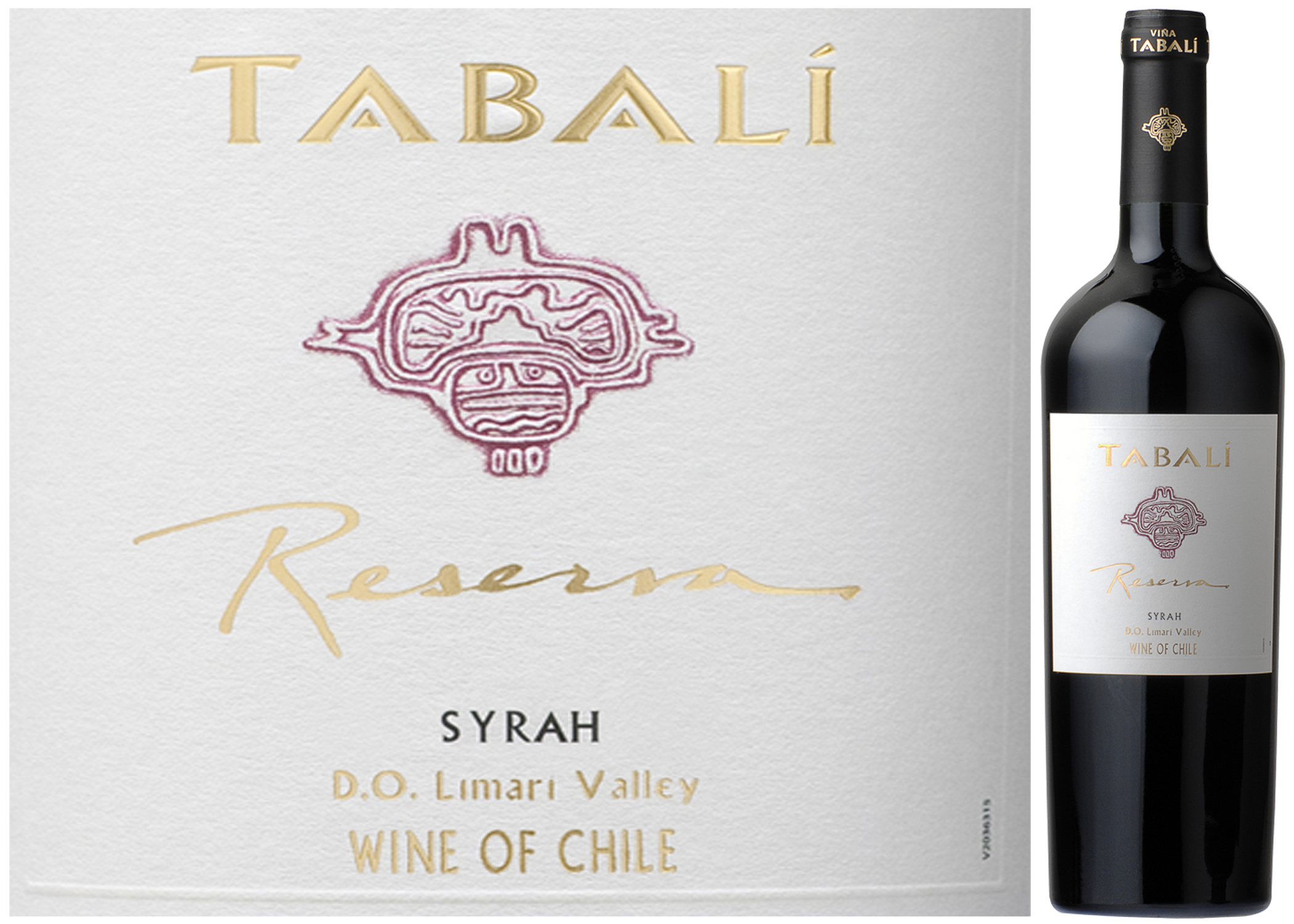
For this week’s DéClassé recommended bottling of Tabali Reserva Syrah 2012,
the fruit is sourced from an alluvial terrace of clay, chalk and limestone silt lying
adjacent to the Limarí River; acting as a conduit for mineral-rich meltwater that
flows downslope from the Andes Mountains. This intriguing and substantial wine
has an appealing balance of tannin structure and softness; helped by a yearlong
maturing in second-use, French oak barrels. This will cellar for some time, but if
you prefer red wines with an acidic brightness—then start drinking immediately!

Tabali

TABALI RESERVA SYRAH 2012
VINTAGES – LCBO Product #662692 | 750 mL bottle
Price $ 14.95
14% Alcohol/Vol.
Sugar Content Descriptor: D

Made in Limari Valley, Chile
By: Vina Tabali
Release Date: October 3, 2015

Tasting Note
This fairly rounded Syrah gives off dark fruit aromas, juicy cherry and black plum
flavours with expected pepper and bitter chocolate notes that define the grape.
Try with roast lamb, braised short rib in leeks or bacon-wrapped tornadoes.

Pinot Blanc Alert

With a thousand years of cultural and regional history, the sometimes turbulent
story of the Palatinate began in the Holy Roman Empire’s early medieval period.
This fertile strip of land, barely 15km wide by 85 long, would eventually become
a coveted set-piece in the positioning between far-off Papal Emperors and the
emerging Protestants. In a middle ground, the successive line of secular princes
anointed as Counts of Palatine pursued a separate agenda of regional ambition.
Centuries of struggle eventually culminated in the 17th century during a so-called
War of the Grand Alliance, when French troops were dispatched northward by
Louis XIV, driving out much of the local population. Emigrating as a group, they
would become known as the Pennsylvania Dutch, though were mostly German.
Specifically, the lands they left behind are Rheinland-Pfalz: a modern state within
the German Federation whose bountiful grape-growing zones are bounded by
the west bank of the Rhine River and the densely forested Haardt Mountains.

The sheltered, relatively warm and dry microclimate in southwest Germany, has
helped Pfalz to earn an affectionate title: the Tuscany of Germany. Several steps
along in the region’s viticultural practice and shifting climate, they’re now able to
cultivate white asparagus, fig, almond, kiwifruit and lemons! The comparisons do
diverge though when it comes to the differing grape varieties that flourish in the
respective regions. In Pfalz, apart from the success in cultivating Dornfelder and
Spätburgunder (Pinot Noir), it’s mainly about finessing their varietal white wines: Gewürztraminer, Riesling in various styles, Grauburgunder (Pinot Gris), Sylvaner,
Muscat, and more recently for this vintner – Weißburgunder (Pinot Blanc).

One of the visionary projects in the diverse portfolio of winemaker Ernst Loosen,
Weingut JL Wolf, now rebranded as Villa Wolf, is building on traditions begun in
the mid-18th century. The task of reinvigorating this particular estate just outside
of Wachenheim, is very much in keeping with the progressive mindset that has
methodically blossomed in the surrounding vineyards of the other 130 regional
villages; linked by the famed Deutsche Weinstraße (the German Wine Road).

Whereas Pinot Blanc has been derisively referred to as Pinot Bland elsewhere,
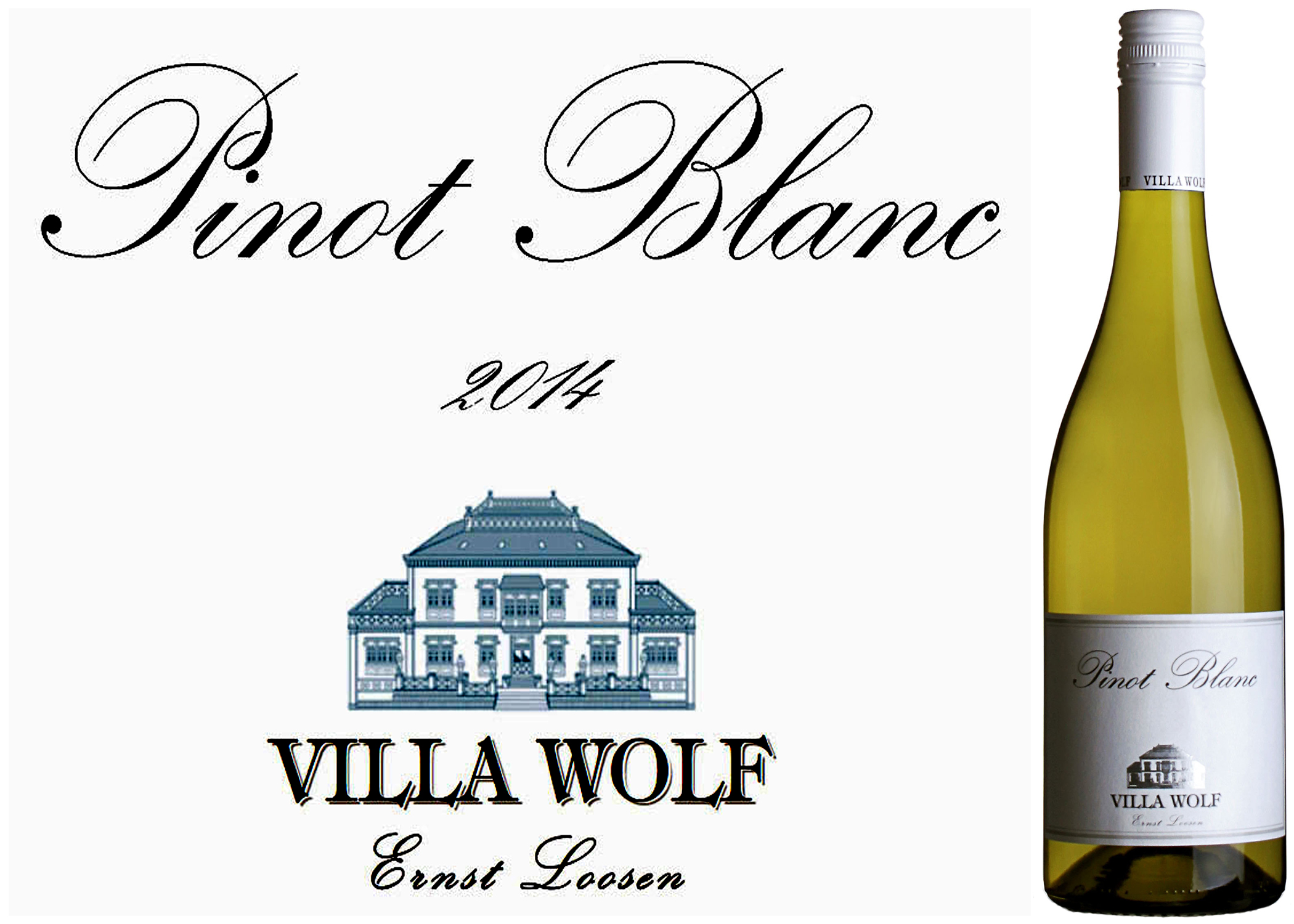
in this week’s DéClassé featuring of Villa Wolf Pinot Blanc 2014–this couldn’t
be further from the case. Certainly it’s a lighter wine style, but one that uniquely
benefits from the Pfalz’s sandstone soils and climate; better ensuring a harvest
of fully ripe grapes. The minimal processing and fermentation with natural yeast
yields a crisp, fruit-driven wine with a delightful purity. Stock up your wine-larder
now, knowing that 2 or 3 bottles – makes an excellent pairing for Thanksgiving!

Villa Wolf

VILLA WOLF PINOT BLANC 2014
VINTAGES – LCBO Product #374959 | 750 mL bottle
Price $ 14.95
13% Alcohol/Vol.
Sugar Content Descriptor: D

Made in Pfalz, Germany
By: Ernst Loosen
Release Date: September 19, 2015

Tasting Note
Pleasingly tart and refreshing, the apple aromas and apricot flavours finish with
a light dusting of sweet herbs. Well paired with roast chicken or veal, fresh pea
risotto or smoked ham and cucumber salad as lunch fare.

Ripasso Alert

Often thought of as a singular, blended wine style, the prodigious vintners and
their vineyards in the Valpolicella DOC actually produce a spectrum of grape
varieties and blending recipes; finished in a range of grades and styles including
Classico, Superiore, Ripasso, Amarone and Recioto. Alternately referred to as
the Pearl of Verona or Verona’s Garden, the two adjacent valleys and plain that
comprise Valpolicella are nestled among the hills of Monti Lessini with the Adige
River acting as a boundary to the south and west. Apart from the storied city’s
anointment as a UNESCO World Heritage Site, its surrounding agricultural zone
is also recognized for the fashioning of youthful wines that unabashedly display a
vibrant and fruity character; intended for early consumption within 3-5 years. In
this week’s DéClassé feature of Storia Antica Ripasso Valpolicella 2013, many
of these attributes shine and are amply demonstrated in the bottle.

The typical vine stock planted here is Corvinone, Rondinella, Molinara and the
region’s signature variety: Corvina Veronese. One of the many local methods of processing wine is called Ripasso (to go over again). This is an ancient vinification
technique that 
likely was adopted from the Greeks; further developed by Romans
to make sweet Recioto della Valpolicella, then later refined for making the region’s fulsome wine star: Amarone. What all these styles have in common is the grape
drying process called appassimento, whereby optimally ripe grape bunches are
picked long after the main harvest and laid out to dry on Arele (bamboo racks).
Having reaching the desired concentrations of sugar and glycerin content, the
withered grapes are slowly pressed to yield the fermenting nectar that will over
five long years become Amarone; the residual pomace is re-purposed by being
added to a partially aged Valpolicella base wine, prompting a second fermentation
that elevates the alcohol content by 2% while adding tannin, colour and richness.
Add a year spent in barrels – it becomes Ripasso della Valpolicella Superiore.

The style has again become popular with red wine lovers longing for somewhat
bolder versions of the easy drinking, regional blend though still nimbler than the heavyweight and significantly more expensive Amarone version. Given the effort
that’s been invested in this bottling; paying a few extra dollars above the average
price-point for standard Valpolicella is more than justified. It’s ready. Decant.

Storia Antica

STORIA ANTICA RIPASSO VALPOLICELLA 2013
VINTAGES – LCBO Product #273672 | 750 mL bottle
Price: $ 15.95
Wine, Red Wine
13.0% Alcohol/Vol.
Sugar Content Descriptor: D

Made in: Veneto, Italy
By: Le Ville Di Antane S.R.L.
Release Date: Sept. 19, 2015

Tasting Note
A nicely extracted Ripasso with delicious aromas of blackcurrant, chocolate 
and
peppery spice. Medium-bodied, dry and flavourful with a pleasing, zippy freshness.
An excellent choice for barbecued beef, mushroom risotto and aged cheeses.

Chardonnay Alert

In 2011, the European Union reclassified wine in an effort to streamline the too
wide-ranging, comparative designations. In France, this now breaks down as AOP Appellation d’Origine Protégée: the premier classification with a fairly strict set of requirements; IGP Indication Géographique Protégée: an intermediate category
with more 
flexible regulations and a greater diversity of permitted grape varieties,
and lastly, Vin de France: a more generic designation that allows cuvée (blending)
of wines sourced from different French regions.

Languedoc-Roussillon is by far the biggest and most prolific IGP region, whose
2,800 wine producers are drawing on approx. 200,000 hectares of vineyard.
It also provides the namesake of d’Oc into the classification, likely derived from
Lange d’Oc: one of two still actively spoken Provençal languages, whose historic
and cultural roots lie in the formerly independent kingdom of Aquitaine. Present
day boundaries stretch between the Spanish frontier to the west, the Loire to
the north, the Rhône region of the Gard to the east, and the Mediterranean Sea.

Slightly over 90% of all Pays d’Oc IGP bottling is varietal wine though the grape
varieties employed in the modern age bear little resemblance to those planted by
Greek traders in the 5th century. Nonetheless, these are widely acknowledged as France’s oldest vineyards, producing many of the country’s best value wines. As
for Chardonnay, the latter descriptor is certainly the case now, 45 years on from
the comprehensive overhaul that was undertaken in the early 1970’s, replacing
large areas of unremarkable vine stock with noble grape varieties such as Cab Sauvignon, Merlot, Chardonnay and Viognier. Despite some rising and falling of commercial success, there’s been a steady commitment to quality-advancement
while maintaining competitive and attractive price-points.

Flourishing in a diverse set of global regions, Chardonnay can be finished in a
broad range of styles; influenced equally by climate and the variable traditions at
work in its source terroir. In Languedoc-Roussillon, apart from being a generally
hot and dry zone that yields fully mature grapes, the easy-drinking Chardonnay
style being produced here is decidedly on the lighter side of the sliding scale. As
for this week’s DéClassé featured wine: Villa Blanche Chardonnay from vintner
Calmel & Joseph – this is a delightful virtue. Their fruit is harvested in staggered
batches to maintain a balance of brightness and body, and since only about 30%
of the vintage is barrel-aged for three months, the oak presence is integrated.

This will unlikely be the richest or complex Chardonnay you’ve tasted, but it will
be an enjoyable, easy-going and satisfying partner for brunch or lighter, dinner
food-fare. Note that this perennial, regular listing favourite might be tucked into
the LCBO’s somewhat more exclusive Vintages section. That says a great deal
about this overachieving offering. Buy one, then if you’re inclined – half a case!

Villa Blanche

CALMEL & JOSEPH VILLA BLANCHE CHARDONNAY 2014
LCBO Product #375071 | 750 mL bottle
Price $ 13.95
13.5% Alcohol/Vol.
Sugar Content Descriptor: XD

Made in: Roussillon, France
By: Calmel & Joseph
Release Date: September 5, 2015

Tasting Note
As expected from the region, this medium-bodied, light green-yellow wine has
pear and grapefruit aromas along with some delicate touches of vanilla and
butter flavour. A natural complement to oysters and mussels, you might also
try with Cassoulet: the signature dish of beans, sausage and confit of duck.

Swartland Blend Alert

Over the 67-year span since 1948, development of the Swartland Winery just
outside of charming and historic Malmsbury has kept a steadfast pace with the
maturing of its vine stock. Sprouting up from the undulating scrubland that these
vineyards occupy, un-trellised, gnarly bush vines personify the determined spirit
at work in the land’s nature and its prolific farmers; both are deeply rooted and
at home on the sprawling ranges of greater Swartland.

Thought of as the breadbasket of South Africa, this diverse agricultural zone in
the country’s Western Cape Province is conducive to crops of wheat, canola,
fruit orchards of all sorts and somewhat surprisingly: olive groves. For cultivation
of grapevines in the unirrigated, dry land conditions that exist at the periphery of
more arable parcels, there’s an unavoidable requirement for the wine makers to
perform a balancing act: Stressed vines inherently produce low yields of grapes;
sometimes too marginal a yield can result in small producers failing to achieve
commercially viable volumes of wine output. On the other hand, as a trade-off,
the very same factors in this arid terroir, desirably encourage the development
of far more interesting fruit; enriching the base – for the building of quality wines.

As evidenced by this week’s DéClassé recommended winery and their bottling of
a Reserve Cabernet Sauvignon/Merlot blend from 2013, this vintner has found
ways to imaginatively exploit the trade-off, as a strength in a challenging landscape
and business model. While taking into account that this is their entry-level wine,
it is nonetheless remarkable that it’s being made available at this price-point!

Cellarmaster Christo Koch evidently stands as a good example of the leadership
steering South Africa’s continuing renaissance of profile and competitiveness in
the global marketplace. Wisely, this current generation is dedicated to refining
the regional distinctiveness of character; reflecting terroir more directly in an
unfettered manner; largely eschewing production practices that might serve to
homogenize their wines. The latter trend is a difficult one to side-step, as a result
of commercial pressures and the employing of distinctive grape varieties which
originate from other regions. In short summary, the prevailing philosophy here
in Swartland’s estates seems to be: create appealingly rustic, honest wine that’s
reflective of soil and climate, with minimal processing interference. Bravo!

The blending of Cabernet Sauvignon and Merlot is discernibly a near-Bordeaux
recipe that’s been adopted and skillfully adjusted to better suit how these grape
varieties ripen in South Africa. If you are a fan of the medium-bodied, red table
wines from the benchmark French region, then this will be very satisfying. If you
are not yet hooked, then this offering should build both affection and a deeper
appreciation for how well they’re able to craft it in Swartland. Enjoy now-2017.

Swartland

SWARTLAND WINERY RESERVE CABERNET SAUVIGNON/MERLOT 2013
VINTAGES – LCBO Product # 419648 | 750 mL bottle
Price $ 12.95
14% Alcohol/Vol.
Sugar Content Descriptor: XD

Made in: Swartland, South Africa
By: Swartland Wine Cellars
Release Date: September 5, 2015

Tasting Note
This Ruby hued, medium-weight red has the expected red berry fruit flavours
and aroma typical of these grape varieties, accented with spice and Vanilla.
Preferably served with foods to balance its 14% alc. – try with grilled zucchini
and sweet peppers, pork or beef tenderloin medallions topped in a Madagascar,
green peppercorn sauce.